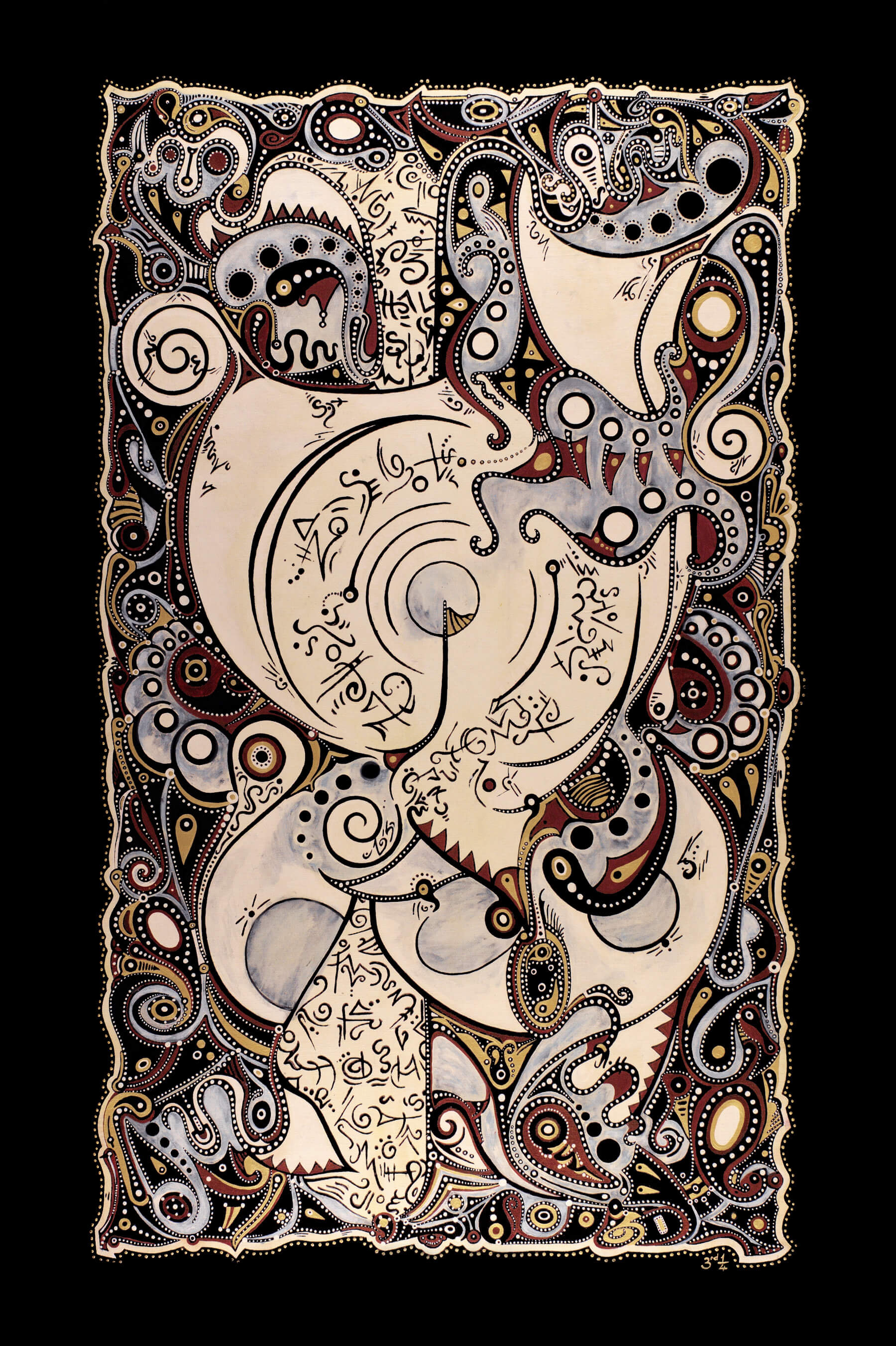
Suspended in time for the next thirty years, inside the bubble of its own assumption, the work was shown, then wrapped, then shown again - its latent forces never fully activated.
It didn’t sell.
It didn’t fade.
It waited.
When the work was unwrapped again, after three decades of movement and churn, it brought the old delight with it, but something else had entered the frame.
What was once painted as hope now appeared uncanny. Not because the work had knowingly predicted the future, but because the image seemed to hold more than was consciously seen at the time. History had moved against the promise it carried.
The burst was still there.
The bloom was still there.
But so was its opposite.
The work hadn’t changed. The trajectory had.
In 1994 the work held Ireland opening without vanishing. A country expanding into something more worldly and unrestrained.
It believed in contact. It believed in fusion. That encounter could enrich without erasing.
That belief was not naive.
It was Irish.
Quintessentially so.
Céad Míle Fáilte was never just a slogan. Ireland’s welcome is real.
Rooted in a shared history of colonisation, hunger, exile, linguistic erasure, memory, and kinship. In a diaspora stretching Irishness into every corner of the world without becoming an empire.
Irish people knew what it was to be scattered and dependent on the humanity of strangers, often not forthcoming. They knew what it was to carry home inside song, story, laughter and loss.
The inversion cuts so deeply because the wound is welcome weaponised.
What began as invitation has been driven into overwhelm. An eruption of life has turned into entropy: the promise of bloom distorted by displacement, infrastructural strain, ideological coercion, and a political class willing to shame Irish people out of defending their own cultural continuity.
A culture can open without vanishing. But no society can absorb endless strain without consequence. Especially when ordinary people are frightened into silence about what is plainly unfolding around them.
When people are pushed to the edge, priced out, humiliated, and made afraid to speak, anger looks for the easiest visible target.
The rage produced by policy and institutional contempt begins to attach itself to the people standing in front of us: the stranger in the supermarket, the family in the rental queue, the person given shelter while those rooted in Irish life are told to wait, move, accept, disappear.
This is how rupture is manufactured.
That is how a naturally welcoming people are stripped of their own nature.
Not by those who arrive, but by those who create the conditions of division and scarcity, then leave people to hate one another inside the distortion.
A Celtic Bubble refuses that trap.
It doesn’t scorn the infusion.
It mourns the corruption from inclusion to coercion: the contortion of a national instinct that has always been generous, balanced, and free. The people removed from the discussion, the decision, and the democratic process itself.
A Celtic Bubble is no longer a suspension of its original assumption alone, but now precariously poised between bloom and rupture.
The image returns as symbol.
The bloom, the surge, the excitement - all real. Yet now a disquieting revelation.
A threshold opening.
Not toward bloom - but extinction.
Same burst.
Opposite future.
A celebration alone no more.
Emergence becoming emergency.
Hovering between two futures.
One still open, cohesive, and secure in selfhood.
One driven to exhaustion, hostility, and rupture through overloading and engineered division.
The image now a volatile symbol - not against ordinary people, but of recognition.
For those who still remember the bloom, who still believe welcome and heritage need not become enemies, and who can feel the growing distance between belonging and dispossession.
Returning now to an Ireland in fracture, it asks whether Irish culture can endure as a living inheritance, seen, heard, embodied, and passed on, or retreat once again into preservation. Observed behind glass. Eulogised as relic and memory alone.
A Celtic Bubble is both auspice and omen. But an omen is not a eulogy.
An omen says there’s still time.
It offers a way for those who feel the tension and fear to speak, yet recognise the reversal without surrendering to hatred, paralysis, or despair. To remember welcome without erasure.
The anger is righteous, but dangerously close to the wrong target.
As rupture looms and the bubble is still bursting, that future is not yet sealed.
We can still gather quietly around what survives: the right of a people to remain themselves while remaining humane. The will to keep pressure, fear, and ideological manipulation from turning neighbour against neighbour.
The first act is recognition.
The next is making recognition visible.
Quietly raising a flag.
A symbol no longer confined to storage, gallery walls, or private interpretation.
Seen unexpectedly.
Recognised instantly.
Carried without explanation.
A reminder that the bubble has not yet burst.
The bloom not beyond retrieval.
The living core not beyond repair.
Not certainty.
Not consensus.
Refusal to disappear into rupture.
↑